
The digital industry spent several years reassuring itself with one idea: artificial intelligence would change the way designers, marketers, and developers work, accelerate production, and take over routine tasks, but it would not replace valuable professionals. Today, that debate already feels outdated. The replacement has happened — not in the sense that these professions have disappeared, but in a way that matters far more to business: a significant share of the work that once required paying an individual specialist or an agency can now be done by AI well enough, fast enough, and at a fraction of the cost.
“Good enough” turned out to be the decisive factor. AI does not need to become the best designer, developer, or copywriter on the market. It only needs to produce work at a level the client can reasonably perceive as professional. Design makes this especially clear. Someone without formal design training rarely sees the difference between a genuinely strong system and a visually convincing imitation of one. They are not evaluating the grid, microtypography, rhythm, compositional relationships, or the dozens of decisions that separate senior-level work from something that is simply polished. They see the page as a whole. If it looks contemporary, clear, and convincing, that is often enough.
The same shift has taken place across code, content, and much of digital production. AI is already capable of performing at a level that, for a vast number of everyday commercial tasks, effectively removes the need for a dedicated specialist. Professionals still see the flaws and limitations. Clients often do not see them at all, or do not consider them significant enough to justify paying for the difference. As a result, the market is no longer evaluating the ideal professional outcome. It is evaluating the balance between price, speed, and acceptable quality.
That is why what is happening cannot be reduced to another phase of automation. The source of an agency’s value has changed. For a long time, a digital company was valuable because it could assemble the people required to do the work: think, design, write, build, code, launch. Production was expensive, slow, and dependent on access to skilled specialists. That scarcity is now disappearing rapidly. One strong person working with AI tools can produce the volume of work that only recently required a team. A client can obtain a website, a visual concept, a prototype, or dozens of communication directions almost instantly.
The signals are already visible in hiring. Tech hiring remains well below previous levels, demand for designers, marketers, and some engineering roles is declining, and a significant share of published openings remain permanently “open” without leading to actual hires. At the same time, AI-related layoffs are increasing, along with the number of specialists who spend months unable to find a new role. The same pattern is visible across the agency market: many Shopify, digital, and marketing agencies are losing a stable flow of clients, reducing teams, and urgently trying to reinvent their model. The direction is clear: agencies that continue to sell standard digital services as their core value will die out in the next few years.
So who remains?
My forecast is fairly simple: the agencies that survive will be those with genuinely strong proprietary expertise — experience, a method, or a way of thinking that cannot be reduced to a production function. The ones capable of doing something AI still cannot simply do in their place.
And if this feels like an unprecedented moment for the market, it is worth looking at the last two hundred years. New technologies have repeatedly devalued established professions and functions, forcing markets either to disappear or to reorganize around a new source of value.
One of my favorite examples is what happened to painting after the invention of photography. Before photography, the ability to record a face, a space, or an event with visual accuracy was one of the artist’s most important functions. A portrait required time, skill, and money. The camera radically changed that economy: an image could suddenly be produced faster, more cheaply, and with greater literal accuracy. Photography did not destroy art, but it ended painting’s monopoly on reproducing visible reality.
That was precisely when a different question became essential for artists: what can I do that a camera cannot?
The answer was a move away from literal representation. Impressionists began working with light, perception, and the sensation of a moment. Later, the avant-garde, Cubism, and abstraction pushed even further away from the obligation to reproduce what the eye could already see. Artists no longer had to compete with the lens on accuracy. Their value shifted toward something the lens could not provide on its own: interpretation.
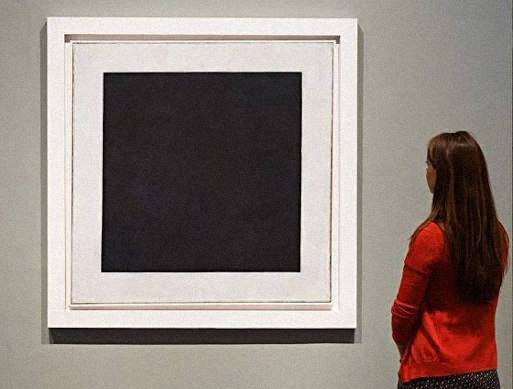
In that sense, Kazimir Malevich’s Black Square remains one of the most radical symbols of this transition. The work effectively rejects the idea of painting as a copy of the external world. The value of art moves from the question “How accurately is this painted?” to “What can the artist see, formulate, and create that does not already exist in front of the camera?”
The market for painting did not disappear. It reorganized itself around a new source of value.
I believe something very similar is happening now with digital agencies. AI is becoming to our industry what the camera once became to a large part of visual production. Competing with it on the speed of building a website, the number of design directions, or the volume of content produced makes little sense. It will only become faster and cheaper.
At the same time, a significant part of the digital and marketing agency market continues to defend its previous position. The industry argues that AI will never reproduce human taste, experience, empathy, or the depth of professional judgment. In individual cases, that is entirely true. The problem is that the market has already made its decision independently of the professional debate. A client does not need to understand why one design is better than another. They only need to decide that the difference is no longer worth the old price.
The agency industry effectively has two paths. It can spend the next several years defending the old economics of production, competing for a shrinking volume of traditional digital work and losing value alongside it. Or it can accept the new rules of the market and determine what expertise remains genuinely scarce once execution itself becomes accessible to almost everyone.
For VESNA©, that question became the turning point in its own transformation. That is why the new VESNA© has reduced its offering to a single service — Commercial Decision Transformation.
Kate Kolody Founder of VESNA© and Elix Fióra©, author of “140 Strategies That Drive Buying Decisions,” and host of The White Room