





How VESNA© Rebuilt IDA Sports’ Visual Direction Around How Customers Really Choose
IDA Sports makes soccer cleats designed around female anatomy. The brand had a strong product and a compelling reason for being: athletes were finally being offered footwear developed for their bodies, fit, and movement patterns. Yet its visual communication told a different story. Its photography portrayed the players in a sweet, youthful, almost childlike way — the way adults often see young girls.
The athletes saw themselves differently. That disconnect became the starting point for the project.
VESNA© was engaged to develop two visual directions for the new IDA Sports website, establishing the photography, typography, color, interface, and product presentation before moving into site architecture and final design. The work began with DEXI® — VESNA©’s proprietary diagnostic system for identifying the hidden factors that drive or interrupt a buying decision.
DEXI® revealed that the brand understood the buyer’s rational expectations, yet continued to view the athlete largely through an adult lens. Parents could readily understand the benefits of a female-specific fit, along with the product’s safety, quality, and practicality. The visual language reflected the same adult idea of what a girl who plays soccer should look like. This created a precise disconnect: IDA was making a serious, technically advanced product for athletes while portraying those athletes as far younger than they perceived themselves to be.
To determine the right focal point for the brand’s communication, VESNA© examined the brand’s three primary audiences. Girls ages six to twelve were beginning to form their relationships with soccer and athletic brands. Girls ages twelve to sixteen already had preferences of their own and participated in purchase decisions. Parents controlled the budget and assessed whether the purchase made practical sense.
Teen athletes held the greatest influence across the decision-making system. Younger girls naturally looked to older players as models of the next stage they wanted to reach. Parents evaluated whether a purchase was appropriate, while preference for a particular brand was often formed by the child herself. Teenagers generated demand within their own age group, influenced family purchasing decisions, and created an aspirational image for younger athletes.
The decision to center girls ages twelve to sixteen was therefore based on their position within the broader decision-making structure. They occupied the point of greatest influence between the product, the parent, and the younger athlete.
At this age, soccer cleats are already part of how identity is expressed. They shape how a girl steps onto the field, experiences her body, and defines her place within the sport. One athlete may be focused on competition and physical development. Another may value belonging and team culture. A third may use soccer to shape an identity that is feminine, androgynous, restrained, soft, forceful, or expressive. What unites them is the desire to decide for themselves what an athlete can look like.
This audience did not need a protective or patronizing tone. Soccer is built on endurance, discipline, speed, and the ability to maintain control under demanding conditions. These athletes did not want to be portrayed as deprived or in need of sympathy. They wanted the brand to recognize the strength they already possessed.
IDA’s story of female-specific footwear had been communicated in considerable detail and framed largely around a problem: female athletes had gone too long without cleats designed specifically for them. The premise was rationally sound. Emotionally, however, it placed the athlete in the position of someone who had finally been rescued.
Kate Kolody changed the point of view. If women had trained, competed, and won for years in footwear designed around the male foot, their history was first and foremost evidence of strength. IDA’s role was to create a product worthy of the level those athletes had already reached.
That insight became the central expression of the new direction:
HER POWER WAS ALWAYS THERE.
HER FOOTWEAR FINALLY CAUGHT UP.
She was already strong. Now she had footwear built to match.
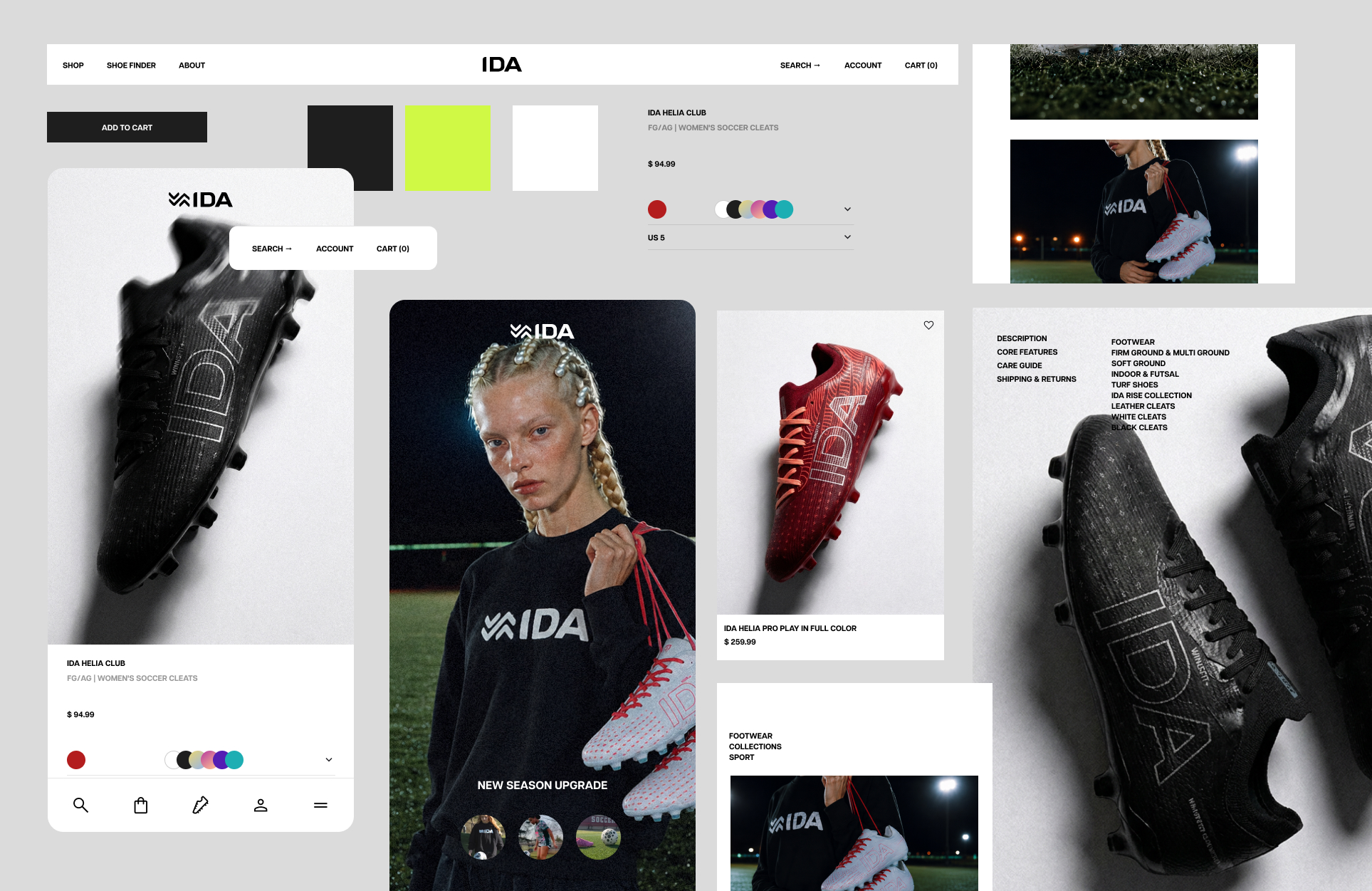
That idea shaped the entire system. The athletes were portrayed as older, more composed, and more physically assured. Low and straight-on camera angles gave them visual authority. Controlled poses, precise movements, and restrained expressions conveyed focus and command. Different forms of femininity and self-expression remained present, united by the stature of a serious athlete.
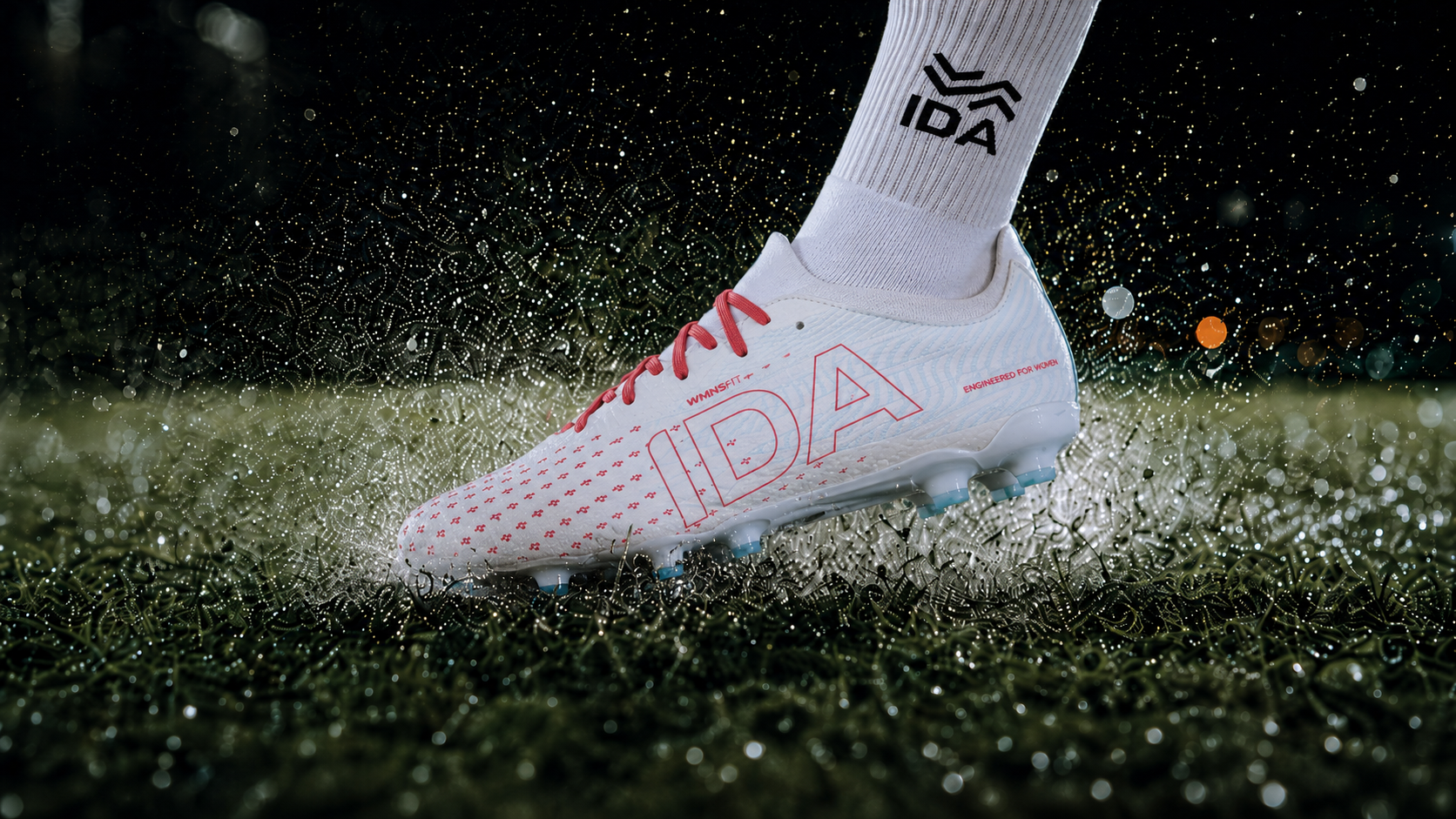
The environment changed as well. The visual vocabulary of soccer has long been defined by daylight stadiums, bright green fields, and conventional game action. IDA was given a territory of its own: night, cold rain, wet grass, deep shadows, and limited visibility.
The extreme environment became a visual metaphor for the conditions female athletes had spent years adapting to. Playing in cleats designed around the male foot meant continually working against a limitation built into the product itself. Even so, women trained, competed, and won. Night, rain, a soaked field, and poor visibility expressed strength already proven: the athlete retained precision and control in an environment that demanded more from her.
An editorial fashion sensibility gave the product cultural relevance. The cleats remained professional athletic equipment while also becoming part of personal style — something to choose, wear, and claim as one’s own. For a teenage audience, that relationship between function and identity was essential.
DEXI® identified another opportunity for growth. IDA’s mission and active community occupied more space in the brand’s communication than the cleats themselves, leaving the product’s technical value visually understated. VESNA© reordered that hierarchy. The anatomical shape, materials, soleplate, studs, and construction details moved to the foreground. Close-up photography presented the cleats as the result of serious engineering, while a restrained interface gave the product room to command attention.
The mission remained intact and gained tangible proof. IDA’s idea was now expressed through the footwear itself — its shape, fit, and construction. The brand began to read as a serious performance footwear brand with a culture and community built around its product.
The same logic informed the user experience. VESNA© proposed removing the separate “Women’s” and “Girls’” categories from the navigation. The distinction complicated the path to purchase and returned the audience to an age label that did not reflect how she saw herself. In the new system, age informed sizing while every customer retained the same status: athlete.
Two visual directions were developed for IDA Sports.
Refined IDA evolved the brand’s existing visual language, preserving its energetic color palette, softer photography, and rounded interface while bringing greater clarity and cohesion to the system.
IDA Evolved introduced a more mature system defined by a nighttime environment, editorial photography, deep contrast, larger-scale product imagery, and a restrained interface.
Together, the two directions allowed the brand to see the possibilities of measured refinement and full evolution.
The engagement covered strategy and creative direction. With disciplined implementation across the website, product communication, photography, and advertising, the projected increase in DTC revenue was estimated at 14.5–17%. Actual performance would depend on the company’s ability to carry the transformation through consistently and maintain a clear, consistent reason to buy across every customer touchpoint. With full implementation, the upside could extend beyond the projected range.
At the center of the project was one defining contradiction. The brand viewed the athlete through an adult lens, while its story focused on what she had lacked. The athletes defined themselves by their strength, discipline, and the level they had already earned.
Of the three audiences, teen athletes held the greatest cumulative influence: they formed preferences of their own, shaped family purchasing decisions, and served as role models for younger girls.
Kate Kolody, Founder of VESNA©
From there, the work unfolded as a precise sequence. The audience defined the positioning. The positioning produced the central idea. That idea shaped the photography, environment, and portrayal of the athletes. The same logic then informed the product hierarchy, interface, navigation, and advertising. Night, rain, a more mature portrayal of the athletes, and large-scale construction details became expressions of a single commercial strategy.
VESNA© is a commercial transformation agency built around the psychology and mechanics of buying decisions. Working with brands, e-commerce companies, and consumer businesses, the agency uses DEXI® and its proprietary commercial frameworks to examine attention, trust, doubt, perceived value, risk, comparison, social proof, and the moment of choice. The point of greatest influence is then translated into concrete changes across product, positioning, websites, user experience, creative direction, content, public relations, customer retention, and the broader commercial system.
VESNA© has one objective: to help businesses become the chosen option. The agency identifies the moment at which a brand loses attention, trust, desire, or ultimately the customer’s choice, assesses its commercial significance, and builds a coordinated system of action around it.
For IDA Sports, that point was the disconnect between the athlete’s internal sense of self and the way the brand portrayed her. DEXI® made the disconnect visible and established the sequence of decisions that followed. The resulting system was built on a deliberate connection between audience behavior, the product, and the business objective.
Every business has a point that determines whether customers choose it. The question is: where is yours?