


Some biographies are easiest to tell through titles and accomplishments. Kate Kolody’s is not.
Her story begins long before her own career — in pre-revolutionary Vladimir Governorate, in an old aristocratic family, a multigenerational mathematical tradition, an inherited visual talent, and several generations of people accustomed to looking for structure where others saw only separate details.
Today, Kolody lives in Santa Barbara. She is an entrepreneur, product and business strategist, designer, author, and host; the founder of VESNA© and Elix Fióra, the author of 140 Strategies That Drive Buying Decisions, and the creator of The White Room, an independent editorial interview project devoted to how experienced people think, make decisions, and navigate complexity.
Her professional career began in 2007 and has unfolded for nearly two decades at the intersection of design, creative direction, digital experience, e-commerce, marketing, and business strategy. Along the way, she has worked with dozens of companies and products, including XEROX, Barilla, Pepsi, and Cadillac.
But a professional résumé explains only part of Kolody.
On her mother’s side, she descends from the Noskov family, an old aristocratic family from Vladimir. Before the Russian Revolution, the family operated bookkeeping offices and maintained a broader portfolio of commercial properties, trading establishments, and other business interests, holding a prominent position in the city’s economic life. With the Bolsheviks in power, the nobility was stripped of its property and legal privileges and subjected to class-based repression. It was this persecution that ultimately forced the Noskov family to flee to Siberia, abandoning their property and concealing their aristocratic origins in order to survive.
The material world disappeared. Some abilities proved more durable.
For generations, the family maintained a strong mathematical tradition. Talent for mathematics, physics, engineering, and finance appeared repeatedly across generations. Many family members studied or graduated from the Moscow Institute of Physics and Technology, MIPT — one of Russia’s most prestigious technical universities.
For Kate, that inclination did not express itself through equations. It emerged in the way she understood complex things: what holds a structure together, which element determines the outcome, and where a single change can alter everything around it.
The Kolody surname comes from her grandfather.
Yaroslav Kolody came from an assimilated Polish family. Kate was deeply attached to him and spent much of her childhood by his side in Crimea. His influence remains central to her life. She still describes him as one of her most important personal references — a man with an exceptional instinct for negotiation, diplomacy, and building relationships.
In the late 1970s, Kolody attracted substantial investment and resources to Zemlyanichnoye (Ortalan) in Crimea. The funding supported new roads, a school serving surrounding communities, tourism infrastructure, and new employment opportunities.
His work changed the scale and significance of Zemlyanichnoye within the surrounding region. The family’s legacy remains visible on the map: one of the village streets bears the Kolody name.
For Kate, this was never simply family history. She grew up alongside someone who understood how relationships, influence, resources, and execution could be brought together to produce tangible change.
On her father’s side, her family history is connected to the Tatar surname Mustafin. In family memory, the Mustafin branch was associated with artists, pronounced visual talent, Soviet cultural life, and people connected to the Soviet political establishment. Artistic ability was not regarded as an isolated interest, but as a recurring family trait.
For Kate, it appeared at the age of five.
A preschool teacher noticed how unusually accurately she copied illustrations from books and told her mother that the child had an obvious talent for drawing.
Within a few years, that talent had moved well beyond an early childhood observation.
Kate began exhibiting her work at a young age. Her drawings appeared in exhibitions in Moscow, throughout the region, and elsewhere in the country. She won art competitions and Olympiads and, at 17, she received a Third-Degree All-Russian Award for Achievement in the Visual Arts — a national-level distinction recognizing artistic achievement across Russia. Later came a full university scholarship and the opportunity to enter a specialized institution without entrance examinations.
Everything pointed toward a life in art.
In a sense, that is exactly what followed. What changed was Kolody’s understanding of what could be designed.
First it was an image. Then an interface. Then a product. Eventually, her attention moved to the behavior surrounding the product — trust, comparison, choice, customer experience, positioning, and the commercial system as a whole.
Design led her to products. Products led her to human behavior. Human behavior led her to business strategy.
That evolution is most visible today in VESNA©, the commercial transformation agency Kolody built around the mechanisms behind buying decisions. Her work brings together product strategy, customer experience, e-commerce, positioning, and commercial systems through a central question: what ultimately determines whether a person says yes?
Within that work, Kolody developed DEXI® — the Digital Experience Excellence Index — her proprietary methodology for examining the factors that shape commercial experience and influence buying decisions.
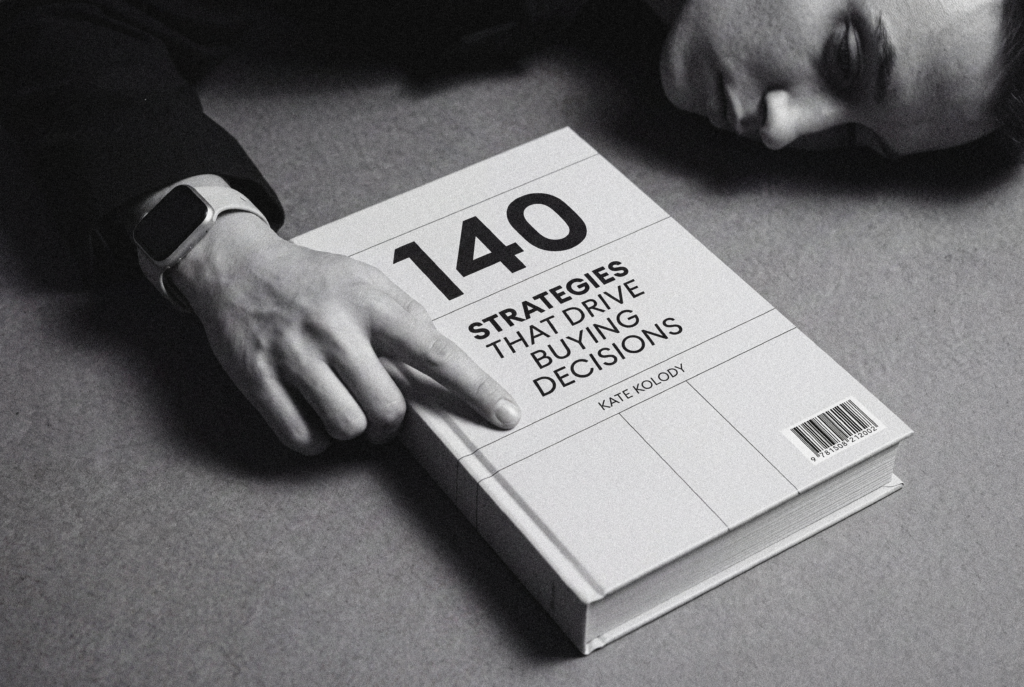
The same fascination with decision-making became the foundation for her book, 140 Strategies That Drive Buying Decisions. It brings together 140 strategies related to choice, attention, risk, comparison, information, time, contradiction, and other forces capable of changing the way people decide.
In Santa Barbara, that interest has taken another form.
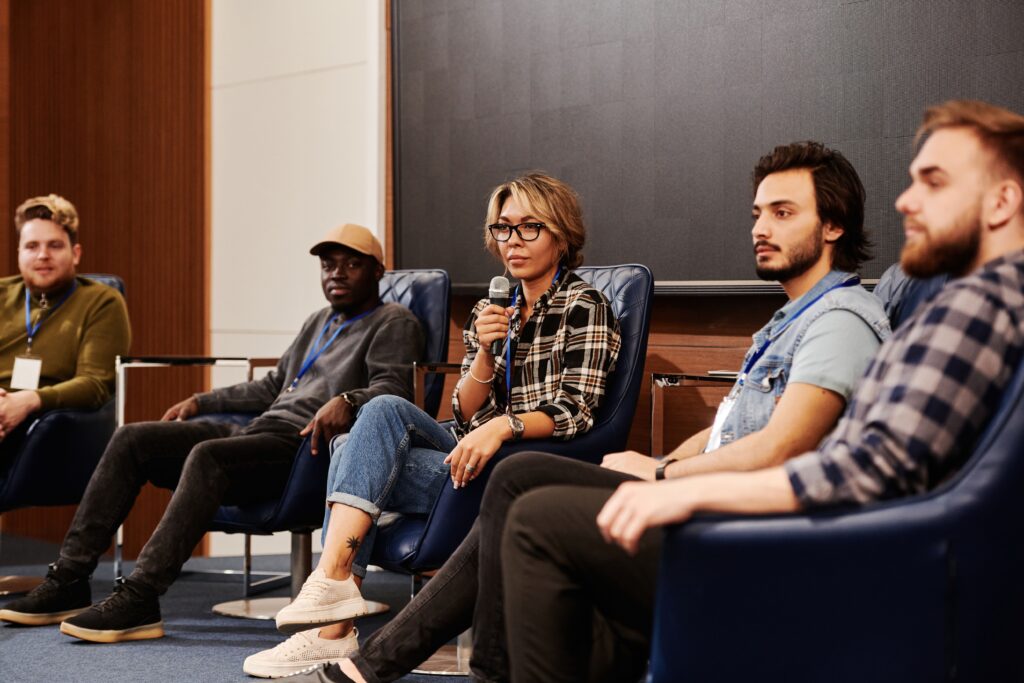
In 2026, Kolody created The White Room, an independent editorial interview project in which she serves as founder, executive producer, and host. Its guests include entrepreneurs, investors, architects, designers, scientists, and authors — people whose work depends on the ability to make consequential decisions.
Kolody is less interested in the conventional story of success than in what happens before the result.
How does an architect recognize the right solution? How does an entrepreneur act when information is incomplete? What does a professional begin to notice after twenty or thirty years of practice? At what point does accumulated experience become what others call intuition?
The White Room is built around those questions. Rather than concentrating on achievement itself, it examines the judgment behind it — years of observation, pattern recognition, mistakes, doubt, refinement, and experience that eventually become almost invisible to the person who possesses them.
In Santa Barbara and Montecito, those conversations feel particularly natural. Architecture, art, entrepreneurship, investment, and private life exist unusually close to one another. People from entirely different disciplines often find themselves confronting the same fundamental questions: how to choose, how to assess risk, what experience is worth, and what makes a decision genuinely good.
It is within this same environment that Elix Fióra is evolving — a premium fashion and lifestyle platform and private community working with independent fashion, beauty, and lifestyle brands.
The project brings together digital commerce, showroom representation, private events, and editorial. Its philosophy is simple: value is created not by the quantity of choice, but by the quality of selection.
In a culture increasingly defined by abundance, selection itself becomes a form of expertise.
That principle connects Elix Fióra to Kolody’s broader work. Whether the subject is a digital product, a buying decision, a business, a conversation, or a collection of brands, her interest is rarely in adding more. It is in identifying what matters, understanding why it matters, and shaping the larger system around it.
Seen in that context, her projects are closely related. VESNA© examines the architecture of commercial decisions. 140 Strategies That Drive Buying Decisions maps the mechanisms capable of influencing those decisions. The White Room explores how judgment develops through experience. Elix Fióra applies the principle of selection to fashion, beauty, lifestyle, and culture.
The same continuity is visible in her family history.
From the Noskov family came a strong mathematical tradition, a hereditary aristocratic legacy, and an instinct for structure. From the Mustafin family came visual talent and an artistic tradition. From her grandfather came an understanding of relationships, negotiation, resources, and scale.
In Kate, those influences developed into a professional trajectory that moved naturally from art to design, product systems, business strategy, entrepreneurship, publishing, and media. What may appear from the outside as several different careers is, in fact, a continuous evolution of the same underlying abilities.
From pre-revolutionary Vladimir through Siberia, Moscow, and Crimea to contemporary Montecito, the family story spans generations of profound historical change. Family status faded from public view, origins had to be concealed, connections were lost, and circumstances changed.
What endured were the abilities that had passed through the family in different forms: an instinct for structure, a visual sensibility, and an understanding of how people, resources, and ideas can be brought together.
In Santa Barbara, Kate Kolody has made those inheritances entirely her own.